
Winning a fence job often comes down to the proposal. Homeowners and property managers compare bids side by side, and the contractor who delivers a clear, detailed, and visually professional proposal earns trust before a single post is set. Yet many fence contractors still rely on handwritten notes, generic spreadsheets, or vague one-line quotes that leave money on the table. This guide walks you through the best way to generate professional fence proposals that close more jobs, protect your margins, and set your business apart from the competition.
Why Professional Proposals Matter in Fencing
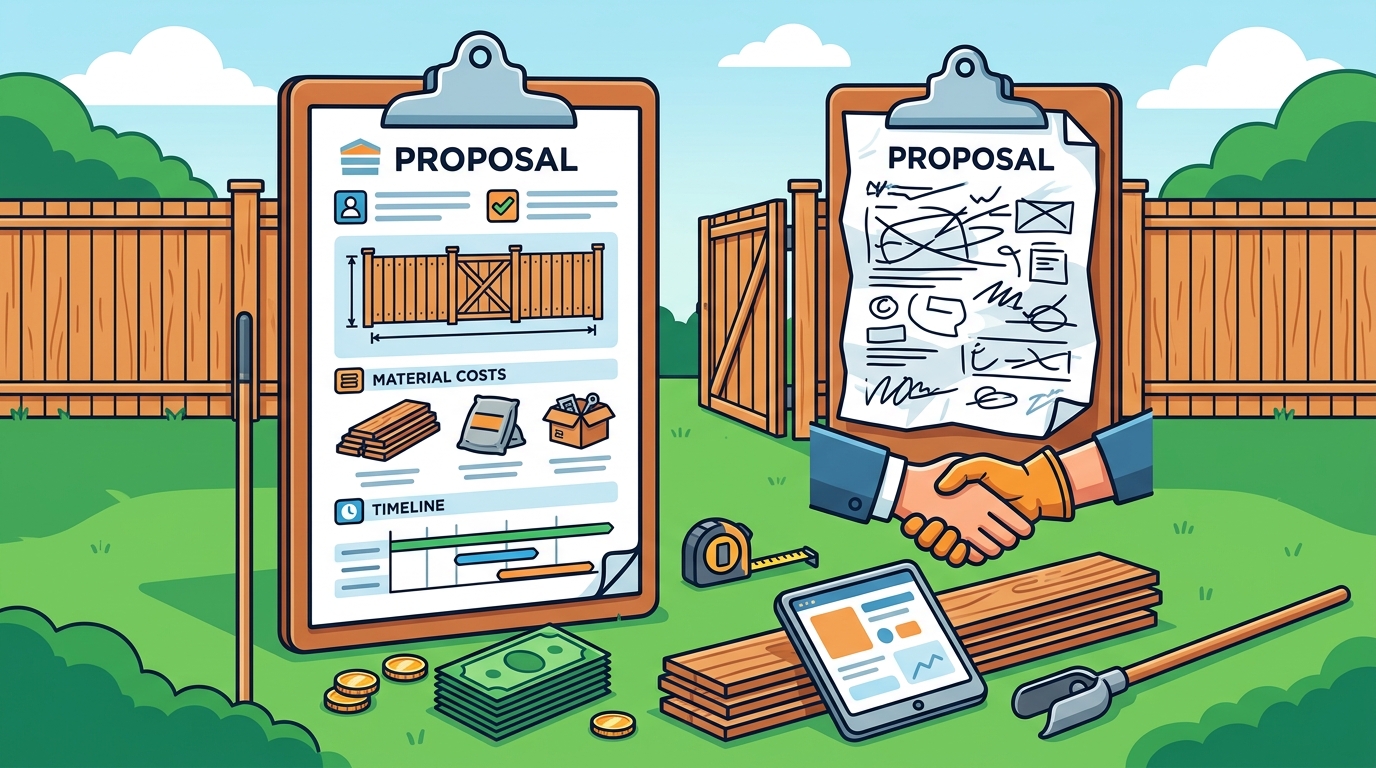
A fence proposal is a formal document that outlines scope, materials, labor, pricing, and terms for a fencing project. It is the primary sales tool a contractor uses to convert a lead into a signed contract.
The data backs this up. According to Loopio's 2026 RFP benchmarks, teams using dedicated proposal software report 18% higher satisfaction with their win rates compared to teams without it. In the fencing world, where the average residential job falls in the $8,000 to $12,000 range, even a modest improvement in close rate translates to significant annual revenue.
Speed matters too. Research compiled by Invoca shows that contractors who respond within five minutes are up to 100 times more likely to qualify a lead than those who wait 30 or more minutes. A polished proposal delivered quickly signals professionalism and urgency.
Anatomy of a Winning Fence Proposal
A fence proposal template is a reusable document framework that standardizes how you present scope, pricing, and terms to every prospect. Great proposals share common elements regardless of fence type.
Essential Sections to Include
| Section | Purpose | Pro Tip |
|---|---|---|
| Company Header & Branding | Establishes credibility at a glance | Include logo, license number, and contact info |
| Scope of Work | Defines exactly what you will install | Specify fence type, linear footage, height, and gate count |
| Material Breakdown | Builds trust through transparency | Itemize posts, rails, panels, hardware, and concrete |
| Labor & Timeline | Sets realistic expectations | Include estimated start date and crew size |
| Pricing Summary | Presents total cost clearly | Offer Good/Better/Best material tiers side by side |
| Terms & Conditions | Protects both parties | Cover payment schedule, warranty, and change-order policy |
| Visual Layout or Shop Drawing | Helps the client see the finished result | Use satellite-based fence drawings for accuracy |
When a homeowner sees a professional, detailed breakdown, it justifies your price and demonstrates thoroughness. This makes them more likely to choose you over a competitor with a vague quote.
Step-by-Step: Building Your Fence Proposal
1. Conduct a Thorough Site Assessment
Walk the proposed fence line and note starting and ending points, corners, slopes, trees, and utility lines. Accurate measurements are the foundation of every accurate estimate. Many contractors now use fence estimating software with satellite measurement to pre-measure a property before driving out.
2. Calculate Materials and Labor
Use the standard formula: measure total linear footage, multiply by per-foot material cost for your fence type, then add posts, gates, concrete, and hardware. Add 10 to 15 percent for waste. For labor, multiply crew size by hourly rate by estimated hours. A standard wood fence typically requires 4 to 6 hours per 100 linear feet with a two-person crew.
3. Apply Overhead and Profit Margin
Overhead allocation rate is your total annual overhead costs divided by projected annual revenue, expressed as a percentage. Typical fence contractor overhead runs 20 to 30 percent. Then apply your target profit margin: 25 to 35 percent for residential, 20 to 30 percent for commercial, and 35 to 45 percent for custom work.
4. Assemble and Send
Pull everything into a branded proposal using professional proposal generation tools. Include a visual fence layout, itemized pricing, and clear payment terms. Platforms like Dirtface let you generate accurate fence quotes in minutes with automated material takeoffs, labor calculations, and customizable pricing for any fence type.
Manual Methods vs. Estimating Software
Many fence contractors still build proposals manually using spreadsheets, paper forms, or generic word processors. While this approach works for very low volumes, it breaks down quickly as your business grows.
| Factor | Manual / Spreadsheet | Fence Estimating Software |
|---|---|---|
| Speed to Quote | Hours to days | Minutes |
| Material Accuracy | Error-prone (8%+ mis-measurement common) | Automated takeoffs from fence type and run length |
| Professional Appearance | Inconsistent formatting | Branded, consistent proposals every time |
| Good/Better/Best Options | Requires manual duplication | Side-by-side material tiers built in |
| Job Tracking | Separate system needed | Integrated CRM, scheduling, and invoicing |
| Annual Margin Protection | Leaks $30K-$60K/year on inaccurate takeoffs | Per-foot material counts reduce waste |
Dedicated fence estimating platforms like Dirtface's estimating software combine quoting, design, CRM, crew scheduling, invoicing, and QuickBooks sync in one cloud platform. This means your proposal data flows directly into job management without re-entry.
Common Proposal Mistakes That Cost You Jobs
Vague scope descriptions. Saying "install fence" without specifying type, height, linear footage, and gate details invites disputes and erodes trust.
Missing visuals. Clients want to see what they are buying. Tools that let you design fence layouts on satellite maps or blueprints give customers a clear picture before construction starts.
Slow response time. In fencing, many inquiries are time-sensitive. A downed fence after a storm, a new puppy, or a pool that needs code-compliant enclosure all demand fast turnaround. The contractor who delivers a measured, signable quote within the hour routinely wins jobs from slower competitors.
No payment terms. Outline your deposit requirements, progress payments, and final payment expectations. This protects your cash flow and sets professional expectations from day one.
Ignoring follow-up. Sending a proposal is not the finish line. Platforms with built-in lead management and texting keep every conversation tied to the right quote so nothing falls through the cracks.
Key Takeaways
- A professional fence proposal includes scope, itemized materials, labor, pricing tiers, visuals, and clear terms.
- Speed to quote is a competitive advantage: respond within minutes, not days.
- Accurate material takeoffs protect $30,000 to $60,000 per year in margin that manual methods leak.
- Presenting Good/Better/Best material options on one estimate closes more upgrades.
- Fence estimating software eliminates re-entry by connecting proposals to job management, invoicing, and scheduling.
- Visual fence layouts built on satellite imagery or blueprints build client confidence before the first post is set.
- Consistent follow-up tied to each proposal is what separates closers from quoters.
Frequently Asked Questions
What should a fence proposal include?
A complete fence proposal should include company information, scope of work, itemized material and labor costs, a pricing summary with optional tiers, a project timeline, terms and conditions, and a visual layout or shop drawing of the proposed fence.
How long should it take to send a fence quote?
Ideally, you should deliver a proposal within one hour of a customer inquiry. With fence estimating software that automates material takeoffs and pricing, generating accurate quotes in minutes is achievable.
What is fence estimating software?
Fence estimating software is a digital tool purpose-built for fence contractors to calculate materials, labor, overhead, and profit for any fence type, then package those calculations into a professional, client-ready proposal.
How do I price a fence job accurately?
Use the four-step formula: calculate material costs per linear foot, estimate labor based on crew size and hours, add your overhead rate (typically 20 to 30 percent), and apply your target profit margin. Most residential fence jobs target a 25 to 35 percent profit margin.
Can I present multiple fence options in one proposal?
Yes. Presenting Good/Better/Best options (for example, cedar vs. vinyl vs. ornamental) on a single estimate lets homeowners compare and often leads to upsells. Dirtface supports customizable pricing for any fence type in one quote.
What is the average close rate for fence proposals?
A typical two-crew fence company closes around 33 percent of bids. With faster, more accurate estimates, close rates can climb to 42 percent or higher, adding roughly one extra job per week at average ticket prices.
Do I need visuals in my fence proposal?
Absolutely. Including a fence layout drawn on a satellite map or blueprint helps clients visualize the finished project, reduces misunderstandings, and increases your perceived professionalism. Dirtface lets you design fence layouts directly on Google Maps satellite view.
How does fence proposal software save money?
Beyond winning more jobs, accurate automated takeoffs prevent material over-ordering and under-ordering. Industry estimates suggest inaccurate manual takeoffs leak $30,000 to $60,000 per year in lost margin for a busy fence company.
Start Creating Better Proposals Today
Ready to stop losing jobs to slower, less professional competitors? Start your free 14-day Dirtface trial with no credit card required. See how automated material takeoffs, branded proposals, satellite-based fence design, and integrated job management can transform how you sell and run your fence business.