
A professional fence proposal is far more than a price on a napkin. It is a branded, itemized document that communicates scope, materials, labor, timeline, and total cost in a way that builds trust and wins jobs. With residential fence projects averaging $8,000 to $12,000 per yard, the stakes on every quote are high. Contractors who invest in polished, accurate proposals close more deals, reduce disputes, and grow faster. In this guide you will learn exactly how to build proposals that impress homeowners, streamline your workflow, and protect your margins from the first measurement to the signed contract.
Why Professional Proposals Win More Fence Jobs
Homeowners compare multiple bids before choosing a contractor. A detailed, professional-looking proposal immediately separates you from competitors who send a one-line text message quote. According to industry benchmarks, residential contractors should target a 25 to 35 percent bid win rate, and professional proposals are one of the fastest ways to push toward the higher end of that range.
Clear proposals also reduce change orders and payment disputes. When every line item, material spec, and exclusion is spelled out up front, both you and your customer share the same expectations. That clarity translates directly into fewer callbacks and faster payments.
Anatomy of a Winning Fence Proposal
A fence proposal is a formal document that details every element of a project, from materials and labor to timeline and payment terms. The best proposals share a consistent structure.
Essential Sections
| Section | What to Include | Why It Matters |
|---|---|---|
| Company Header | Logo, license number, contact info | Builds credibility instantly |
| Scope of Work | Linear footage, fence style, height, gate count | Prevents scope creep |
| Material Breakdown | Posts, rails, pickets, concrete, hardware with quantities | Justifies your price |
| Labor & Timeline | Crew size, estimated days, start date | Sets realistic expectations |
| Pricing Summary | Subtotal, tax, total, payment schedule | Eliminates sticker shock |
| Terms & Conditions | Warranty, permit responsibility, cancellation policy | Protects both parties |
When a homeowner sees a thorough, itemized breakdown it demonstrates your professionalism and makes them more likely to choose you over a competitor with a vague quote.
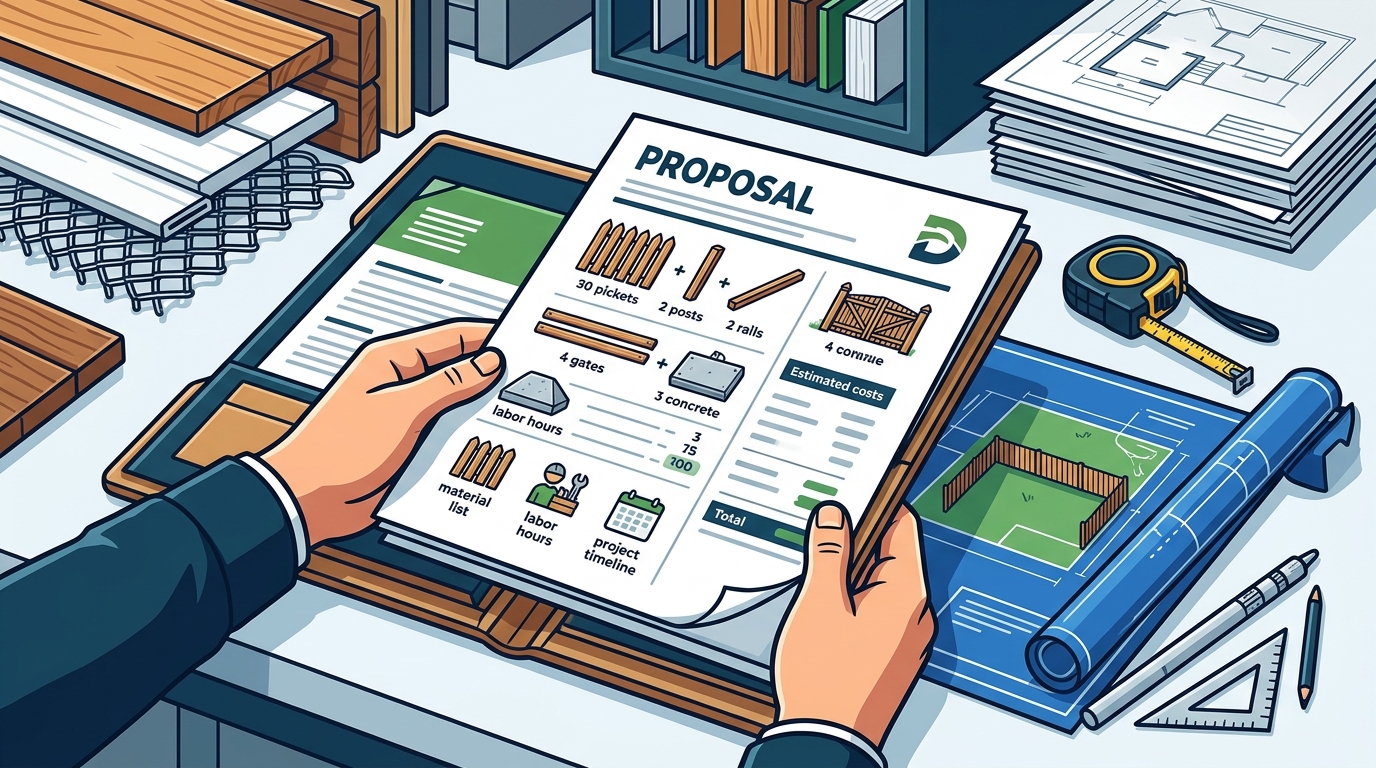
Branding Your Proposals
Consistent branding, including your logo, colors, and a clean layout, signals that you run a legitimate operation. Dirtface's customizable proposal templates let you embed your branding into every quote without starting from scratch each time.
Step-by-Step Process for Creating Fence Proposals
1. Conduct a Thorough Site Assessment
Walk the proposed fence line and note the start and end points, corners, slopes, trees, and utility lines. Use a measuring wheel for long straight runs and a tape for angled sections. Accurate field measurements are the foundation of an accurate proposal.
2. Calculate Material and Labor Costs
Every profitable fencing quote follows a core framework: calculate material costs by multiplying total linear footage by cost per foot, then add posts, gates, concrete, and hardware. Include a 10 to 15 percent waste factor. Estimate labor by multiplying crew size by hourly rate by estimated hours. A standard wood fence typically requires 4 to 6 hours per 100 linear feet with a two-person crew.
3. Add Overhead and Profit Margin
Overhead rate is the percentage of annual overhead costs relative to projected revenue and typically falls between 20 and 30 percent for fence contractors. Apply your target profit margin on top: 25 to 35 percent for residential work, 35 to 45 percent for custom projects. The formula is: Final Price = (Materials + Labor + Overhead) / (1 minus Desired Profit Margin).
How Fence Estimating Software Speeds Up Proposals
A fence estimating tool is software purpose-built to automate measurements, material calculations, and quote generation for fence contractors. Instead of juggling spreadsheets and handwritten notes, you get a single platform that handles everything.
Dirtface fence estimating software lets you generate precise, professional fence quotes in minutes using pre-loaded templates for chainlink, wood, vinyl, and ornamental fences. The system automatically calculates time estimates, labor costs, material lists, overhead expenses, concrete costs, and profits so you can produce a polished proposal on-site.
Software users report higher satisfaction with proposal turnaround time and collaboration. According to Loopio's 2026 RFP benchmarks, teams using dedicated proposal software see an 18 percent higher satisfaction rate with completion speed compared to non-users. That speed advantage matters when a homeowner is comparing three bids and chooses the contractor who responded first.
Beyond quoting, Dirtface also helps you create a complete fence estimate, manage contract add-ons that increase profit, and understand catalog basics for materials. You can even track leads and schedule jobs from the same dashboard.
Common Proposal Mistakes That Cost You Jobs
Vague line items. A single lump-sum number invites suspicion. Always itemize materials, labor, and fees separately so the homeowner understands exactly what they are paying for.
Slow response time. Speed wins. Contractors who deliver proposals within 24 hours of the site visit dramatically increase their chances of closing. Dirtface's quick-start guide shows you how to go from sign-up to sending your first quote in under an hour.
Ignoring follow-up. Most sales happen after multiple contacts. Build a follow-up cadence into your process: a courtesy call two days after sending the proposal, then a check-in at one week.
Forgetting exclusions. Spell out what is not included, such as permits, tree removal, or grading, to avoid margin-eating surprises after the contract is signed.
Key Takeaways
- A professional fence proposal is a branded, itemized document that builds trust and wins more bids.
- Target a 25 to 35 percent win rate on residential bids by combining accurate pricing with polished presentation.
- Always include scope of work, material breakdown, labor estimate, timeline, pricing summary, and terms.
- Use the cost-plus formula: Final Price = (Materials + Labor + Overhead) / (1 minus Profit Margin).
- Fence estimating software like Dirtface cuts proposal creation from hours to minutes.
- Follow up within 48 hours; most jobs are won after multiple contacts, not the first touch.
- Itemize everything and list exclusions to prevent disputes and protect your margins.
Frequently Asked Questions
What should a fence proposal include?
A complete fence proposal should include your company header, scope of work with linear footage and fence style, an itemized material list, labor and timeline estimates, a pricing summary with payment terms, and terms and conditions covering warranty and permits.
How long should it take to create a fence proposal?
With manual methods, a detailed proposal can take one to two hours. Using dedicated fence estimating software, most contractors produce a professional proposal in under 15 minutes, including material calculations and branded formatting.
What profit margin should I target on a fence job?
Residential fence projects typically carry a 25 to 35 percent profit margin. Commercial work averages 20 to 30 percent, and custom or ornamental fencing can justify 35 to 45 percent margins.
How does fence estimating software improve proposals?
Fence estimating software automates material takeoffs, applies pre-set labor rates, and generates branded PDF proposals instantly. This eliminates math errors, speeds up delivery, and presents a more professional image to homeowners.
What is the average bid win rate for fence contractors?
Residential contractors generally target a 25 to 35 percent bid win rate. Rates below 15 percent suggest you are bidding too broadly, while rates above 50 percent may indicate you are underpricing your work.
How can I make my fence proposal stand out from competitors?
Include a visual site sketch or diagram, use branded templates with your logo, itemize every cost, and add a clear timeline. Following up promptly after submission also gives you a significant edge.
Should I send a digital or printed fence proposal?
Digital proposals delivered via email or a customer portal are faster and easier to track. Most modern homeowners prefer a PDF they can review on their phone. Platforms like Dirtface generate shareable digital proposals automatically.
Start Generating Better Proposals Today
Stop losing jobs to sloppy quotes. Sign up for Dirtface and start creating professional, accurate fence proposals in minutes. With pre-loaded templates, automated material calculations, and built-in branding tools, you will close more jobs and grow your fence business faster.